Flying a private jet in winter
By Jake Lombardi. Published .
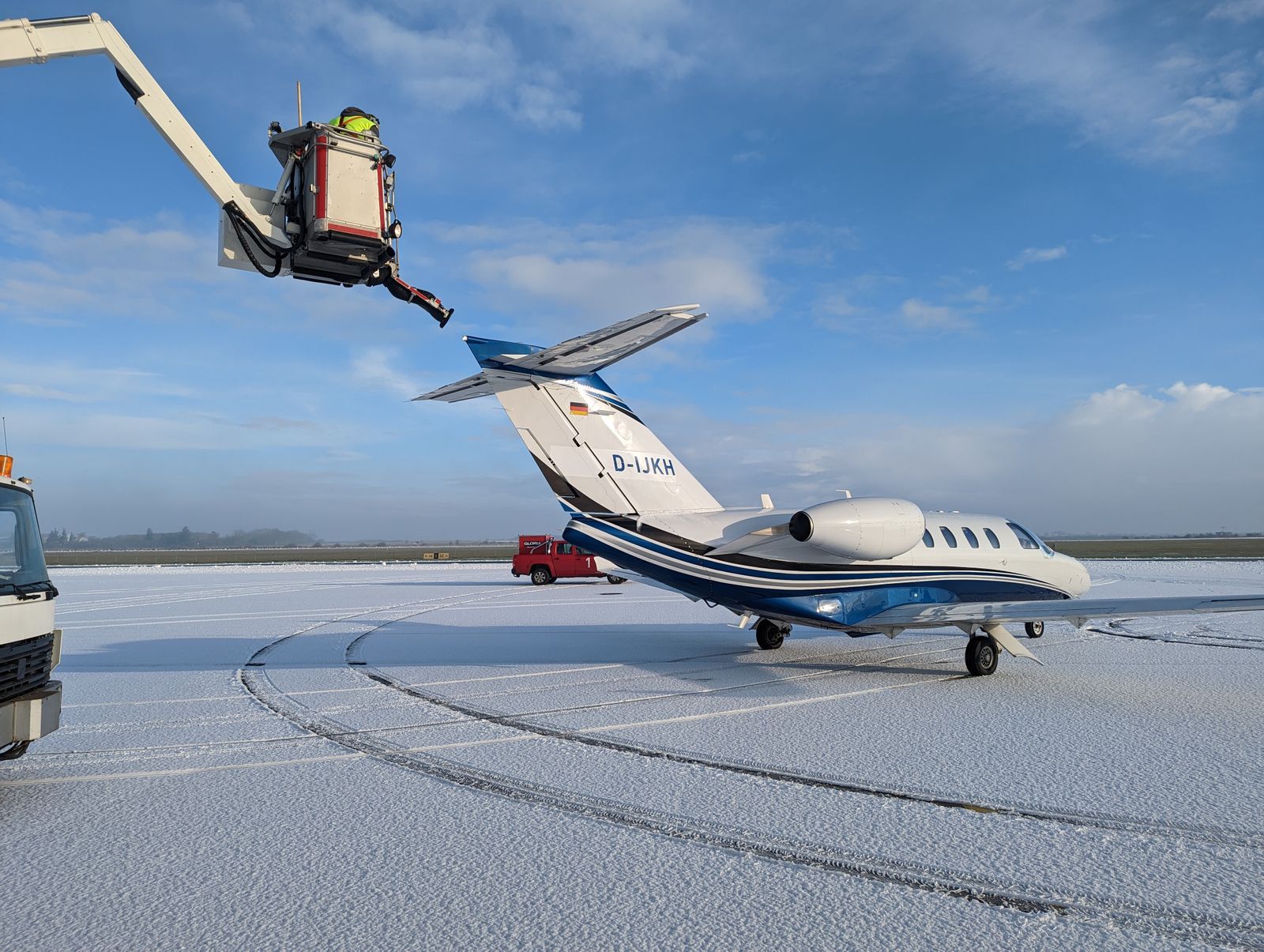
The short answer
In icing conditions a private jet may not take off with frost, ice or snow on it, and the operator needs either a contamination check within five minutes or an approved de-icing programme with a holdover time. That is the rule in 14 CFR 135.227, and it is the reason a New York departure in December can sit on the ramp for forty minutes with the fluid running. Here is how the numbers work, what they cost, and how to protect a connection.
The single most common reason a New York private flight runs late in winter is not weather at the destination, and it is not the aircraft. It is that the aircraft cannot legally leave until someone has removed the frost from it, and that process has a clock attached.
The rules are specific, and they are worth understanding, because “the aircraft was de-iced” is not an excuse. It is a process with a deadline.
The rule
The operative regulation is 14 CFR 135.227, Icing conditions: operating limitations. It applies to Part 135 charter operators, which is what almost every on-demand private flight in the United States is.
The first paragraph is the flat prohibition:
No pilot may take off an aircraft that has frost, ice, or snow adhering to any rotor blade, propeller, windshield, stabilizing or control surface; to a powerplant installation; or to an airspeed, altimeter, rate of climb, flight attitude instrument system, or wing.
No exceptions in the general case. There is a narrow allowance for frost under the wing in the area of the fuel tanks, if the FAA authorises it, and that is about fuel tank chill, not about a usable wing.
The second paragraph is the one that decides the schedule. When conditions are such that frost, ice or snow may reasonably be expected to adhere, the operator must meet one of three conditions:
- A pretakeoff contamination check, established by the certificate holder and approved by the Administrator for the specific airplane type, completed within 5 minutes before beginning takeoff. The check makes sure the wings and control surfaces are free of frost, ice and snow.
- An approved alternative procedure under which the airplane is determined to be free of frost, ice or snow.
- An approved de-icing and anti-icing program that complies with 14 CFR 121.629(c), and the takeoff complies with that program.
Option 3 is what a charter operator uses in practice. Option 1 is the fallback, and it is the reason the fluid can run while the crew stands outside looking at a wing.
What de-icing and anti-icing actually are
The FAA’s definitions, from Advisory Circular 120-60:
- Deicing is a procedure by which frost, ice or snow is removed from the aircraft in order to provide clean surfaces.
- Anti-icing is a precautionary procedure that provides protection against the formation of frost or ice and accumulation of snow on treated surfaces for a limited period of time.
- Holdover time is the estimated time deicing or anti-icing fluid will prevent the formation of frost or ice and the accumulation of snow on the protected surfaces. It begins when the final application of fluid commences and expires when the fluid loses its effectiveness.
That third definition is the one that matters, because it is the deadline.
The holdover times
A holdover time table gives a range, not a number, and the range depends on three things: the outside air temperature, the type of fluid, and the weather.
The tables come from SAE ARP 4737 and ISO 11076. Advisory Circular 120-60 reproduces them in its Appendix 1, and it is explicit that the only acceptable data is the SAE and ISO data, and that holdover times exceeding those in the current tables are not acceptable.
Here is a slice of the Type I fluid table, which is the short-duration fluid used in lighter weather:
| Outside air temperature | Frost | Freezing fog | Snow | Freezing rain |
|---|---|---|---|---|
| 0 °C (32 °F) and above | 0:18 to 0:45 | 0:12 to 0:30 | 0:06 to 0:15 | 0:02 to 0:05 |
| Below 0 °C, to 7 °C (19 °F) | 0:12 to 0:30 | 0:06 to 0:15 | 0:06 to 0:15 | 0:01 to 0:03 |
| Below 7 °C, to 14 °C (below 19 °F) | 0:12 to 0:30 | 0:06 to 0:15 | 0:06 to 0:15 | 0:01 to 0:03 |
Read the first row carefully. At or above freezing, in freezing rain, Type I fluid buys you two to five minutes. That is the number that decides whether a flight happens on schedule.
The Type II fluid table, used on the aircraft a charter client actually flies, is much longer in mild conditions and collapses quickly as the temperature falls. In the SAE/ISO Type II table, at and above 32 °F with a neat (100 percent) fluid, the freezing-rain column reads 0:24 to 1:00. But the same table notes that a buffer of at least 7 °C (13 °F) must be maintained for Type II fluid used for anti-icing at OAT below −25 °C, and it advises considering Type I fluids where Type II is marginal.
How the range is used
The Advisory Circular is unusually clear on how to read a range, and the reading is counter-intuitive:
Generally, for snow, the lower range has been found to be a useful approximation for moderate, steadily falling snow (zero to light winds) while the upper range is a useful approximation for light, steadily falling snow. Therefore as a general rule, the maximum time within the holdover time range applies in light precipitation conditions, and the minimum time applies in moderate precipitation conditions.
So a pilot flying in light snow may use the top of the range. A pilot flying in moderate snow uses the bottom. The SAE and ISO tables also state that holdover time protection is shortened in heavy weather conditions.
The effectiveness of fluid depends on more than the clock: temperature, the moisture content of the precipitation, wind, and the aircraft’s skin temperature all move the number. That is why the pilot in command, not the ramp, has the final word on the time.
What happens when the holdover time expires
This is the part that turns a delay into a missed connection. From 14 CFR 121.629(c)(3), takeoff after the determined holdover time is exceeded is permitted only if one of three conditions exists:
- A pretakeoff contamination check determines that the wings, control surfaces and other critical surfaces are free of frost, ice and snow.
- It is otherwise determined by an alternate procedure approved by the Administrator that those surfaces are free of frost, ice and snow.
- The wings, control surfaces and other critical surfaces are redeiced and a new holdover time is determined.
Option 3 is the expensive one, because it means the truck goes round again. Option 1 is the one that costs time instead of money: somebody walks out and looks at the wing. The check must be completed within five minutes of beginning takeoff, and it is normally done from outside the aircraft.
In practice, on a marginal day, an aircraft can de-ice, sit through a holdover time, fail a contamination check, get re-de-iced, and get a new clock. That is a normal sequence, not a malfunction, and it is why a New York departure in January can drift by an hour without anything having gone wrong.
The rest of the picture
The IFR side. 135.227(c) also restricts flight into known or forecast icing: the aircraft must have functioning de-icing or anti-icing equipment protecting each rotor blade, propeller, windshield, wing, stabilising or control surface and the instrument systems. An aircraft without ice protection meeting the transport-category type certification requirements may not be flown into known or forecast severe icing at all.
Pre-takeoff contamination checks have to be done from outside. Under 121.629(d), an operator without a full approved programme may still operate, but only with a check of the wings and critical surfaces, conducted within five minutes prior to beginning takeoff, and accomplished from outside the aircraft.
Run-up discipline. Teterboro’s own Flight Crew Handbook prohibits jet and turbine engine run-ups on ramp areas, and requires all maintenance run-ups to be conducted between 8:00 a.m. and 8:00 p.m. Monday to Saturday, or 12:00 p.m. to 6:00 p.m. on Sundays. Winter is when engines are worked on hardest, and the run-up windows are narrower than the flying windows.
The crew-time interaction
A winter delay is not only a fuel and fluid problem. It is a crew-duty problem, and this is where Part 135 gets sharp.
Under 14 CFR 135.267, for an unscheduled one- or two-pilot crew, in any 24 consecutive hours the total flight time of the assigned flight added to any other commercial flying by that crewmember may not exceed 10 hours for a two-pilot crew. Exceeding that limit because of circumstances beyond the operator’s control, such as adverse weather, triggers escalating rest requirements: 11 hours if over by no more than 30 minutes, 12 hours if over by more than 30 but no more than 60 minutes, and 16 hours if over by more than 60 minutes.
That is why a long winter de-icing hold can change which aircraft flies your leg at all. If the delay pushes the crew past the limit, the flight needs a different crew or a different aircraft, and a Teterboro departure at 8 am with a de-icing hold and a 2 pm departure from a mountain airport can become a completely different operation.
What it costs
De-icing is billed per event, and the price depends on the fluid type, the aircraft size and the airport. There is no single national number. What can be said generally is that anti-icing fluid is a consumable, the charge is small relative to the aircraft’s hourly rate, and the real cost of a winter de-icing event is the time on the ramp and the schedule risk it carries.
The risk of a missed connection is what actually costs money. A helicopter connection, a yacht booking in the Bahamas, a ski transfer in Aspen, a flight that has to be timed to a meeting, a dinner reservation: all of these break if the departure slips by an hour.
How to protect a connection
Ask whether the departure is de-icing dependent. Not every winter flight is. A departure on a day when the aircraft is already in a warm hangar and the destination is in Florida may never need fluid. A departure into an airport with freezing rain will.
Allow a wider window on the origin side. If a connection matters, the connection should sit after the de-icing window, not inside it. Ask for a departure that gives the fuel cycle room.
Know the destination’s de-icing capability before the origin’s. The aircraft that leaves Teterboro at 8 am in January will be de-icing on arrival in Aspen, Jackson Hole or Vail, and the second event is usually the one that decides whether you make a dinner reservation.
Watch the tail number, not just the aircraft type. An operator that flies a specific aircraft to a specific airport on a specific day has a record at that airport, including noise violations at Teterboro. That record is invisible in a category quote.
Travel with the schedule you can defend. If a meeting is at 2 pm and the flight is 8 am with a fuel stop, the risk is real. Jake will say so at the quote stage rather than after the aircraft is on the ramp.
The quiet upside
Winter is also the best time to fly for another reason, which is worth mentioning because it is counter-intuitive. Cold, dense air is more efficient: an aircraft flies further on the same fuel, burns less per mile, and the fuel load for a given trip is smaller. A cold-weather departure out of New York to a warm destination is one of the more efficient flights you will ever make. The de-icing cost and the schedule risk are the price of that efficiency, and they are worth paying.
What Jake checks
For a winter departure, the forecast at the origin and the destination is checked for icing conditions, the aircraft’s de-icing capability is confirmed against the conditions expected, and the crew duty position is checked against the delay the forecast implies rather than against the schedule as published. If a connection is at stake, the connection is checked with the operator’s dispatcher, who sees the same de-icing reality the ramp does.
If you have a winter trip to price, call +1 (862) 485-3510 or request a quote, and put the date and the connection in the notes so the de-icing exposure can be priced into the answer rather than discovered on the day.
Sources
- 14 CFR 135.227, Icing conditions: operating limitations (eCFR, Title 14, Part 135)
- 14 CFR 121.629, Operation in icing conditions (eCFR, Title 14, Part 121)
- 14 CFR 135.267, Flight time limitations and rest requirements: unscheduled one- and two-pilot crews (eCFR, Title 14, Part 135)
- FAA Advisory Circular 120-60, Ground De-icing and Anti-icing Program, including the holdover time tables in Appendix 1
- Teterboro Airport Flight Crew Handbook (Quiet Flying Program), Revision 4/25
The holdover times, by weather
The clock that starts when the fluid goes on. In freezing rain, at or above freezing, it is two to five minutes.
The freezing-rain row is the one that matters. Two to five minutes is not a schedule cushion, it is a taxi-and-lift window. In freezing rain the aircraft has to be airborne almost immediately after the fluid stops, or the holdover time has expired and the truck has to go round again.
Type I fluid is the short-duration fluid, used on light aircraft and in light weather. Type II and IV fluids buy considerably more time at mild temperatures, and considerably less at low ones.
| Weather condition | Holdover time | What it means |
|---|---|---|
| Frost | 18 to 45 minutes | The generous case. Dry cold air, no precipitation. |
| Freezing fog | 12 to 30 minutes | Supercooled droplets in the air. |
| Snow | 6 to 15 minutes | Wider band than the other conditions. |
| Freezing rain | 2 to 5 minutes | The hard case. Ice forming on contact. |
A holdover time that has expired does not stop the flight. It starts the clock again, or it sends someone out to look at the wing. If a connection is at stake, say so at the quote stage: call+1 (862) 485-3510 orrequest a quote and put the connection in the notes.
Written by Jake Lombardi
Jake Lombardi is the managing director of Lombardi Jet Services. Fifteen years in private aviation and more than 1,000 charters arranged. About Jake
Plan this trip with Jake
Tell Jake your dates and how many are travelling, and he will come back with options and one clear price.
Request a quoteCall Jake: +1 (862) 485-3510
Lombardi Jet Services is an air charter broker. It is not a direct air carrier and does not have operational control of any aircraft. Flights are provided by properly licensed direct air carriers (FAA Part 135 operators, or foreign equivalents), which keep operational control. We act as our clients' agent.